
Dynamic Posture Assessment — Movement-Based Posture Correction and Pain Management
Static posture cannot reveal dynamic movement strategy
Written by Hironori Ikeda, M.Sc. Sports Medicine — Founder, RSM International Academy.
A photograph can describe alignment. It cannot show how a person transfers load from one leg to the other, whether pelvic rotation is coordinated with thoracic rotation, how the scapula responds during an overhead reach, or which strategy emerges under repetition and fatigue. Static posture is a baseline, not the endpoint of assessment.
At RSM, the decisive question is what happens when the person moves. Two people may look similar while standing yet use very different movement strategies during a squat, stride, throw or rotation. By changing the task, support or load, a practitioner can compare movement options, identify relevant findings and decide what to examine next. An experienced eye helps generate better questions; matched re-testing and appropriate clinical assessment are what help evaluate those questions.
What does the postural assessment course in Chiang Mai teach? Bring a movement question, compare an observation at rest with a functional task, and learn how to re-test under matched conditions. The training puts postural analysis in context: it treats alignment as a starting observation, not a diagnosis.
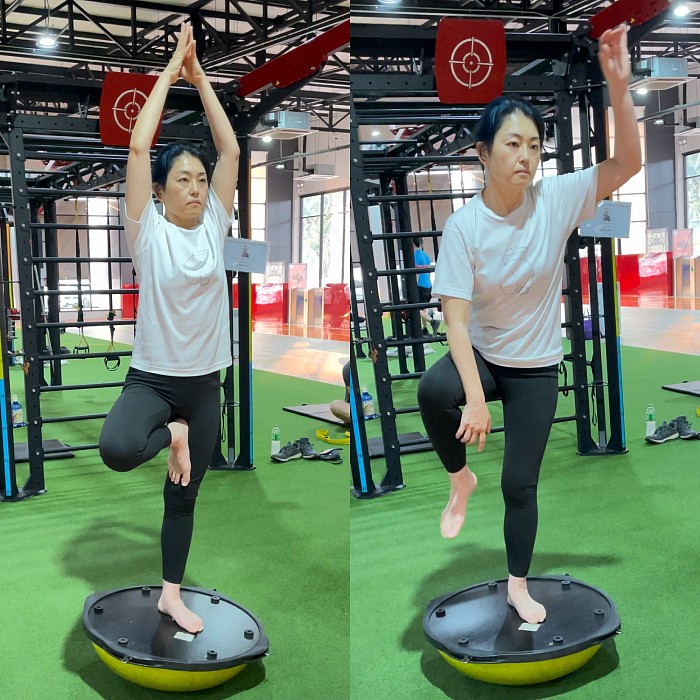
Utilizing an unstable surface, Dynamic Equibalance enhances your proprioception across all joints, enabling kinetic chain engagement from your core muscles. This ensures optimal body alignment, bolstering your dynamic postural stability
Functional anatomy and kinetic-chain assessment
Begin by identifying the symptom or movement limitation and the task that changes it. Observe regional movement, joint range, load transfer and relevant muscle function. Compare the foot, ankle, knee, hip, pelvis, trunk, thorax, shoulder girdle and head as required by the task. Consider both ascending and descending kinetic-chain relationships. A visual asymmetry is a starting point for comparison, not a sufficient explanation of pain.
Compare active joint range of motion, the sequence in which joints move, and which muscles appear to take over as load or speed changes. For example, note whether a reach comes mainly from the shoulder, trunk or pelvis and whether a change in support alters that pattern. Compare both sides and look for habitual movement strategies across tasks. Video shows the movement pattern; use appropriate range, strength and palpation checks to test a hypothesis about muscle recruitment. Do not infer the activation of a specific muscle from posture or video alone.
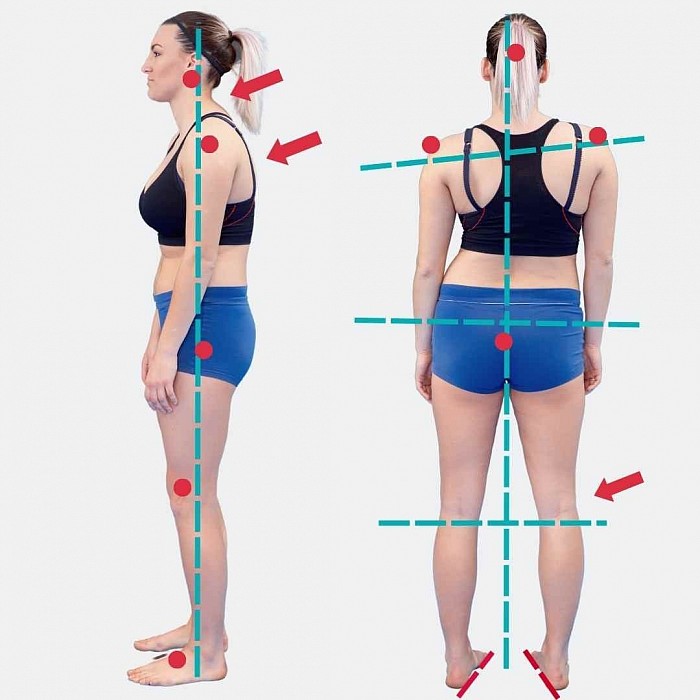
We assess your posture from a sports medicine perspective and guide you towards optimal alignment
Lateral Pelvic Tilt, Lateral Shift and Scoliosis in Posture Assessment
Anterior pelvic tilt and posterior pelvic tilt are descriptions of pelvic orientation. Evaluate whether tilt changes during a squat, hip hinge, stride or active hip extension, and how lumbar motion and hip mobility contribute. During a step-down, look from the front. A lateral pelvic shift moves the pelvis sideways over the supporting foot. With lateral pelvic tilt (pelvic obliquity), one side of the pelvis sits higher than the other. A lateral trunk shift describes how the rib cage moves sideways relative to the pelvis. Compare both sides and note which movement changes when the person uses light hand support.
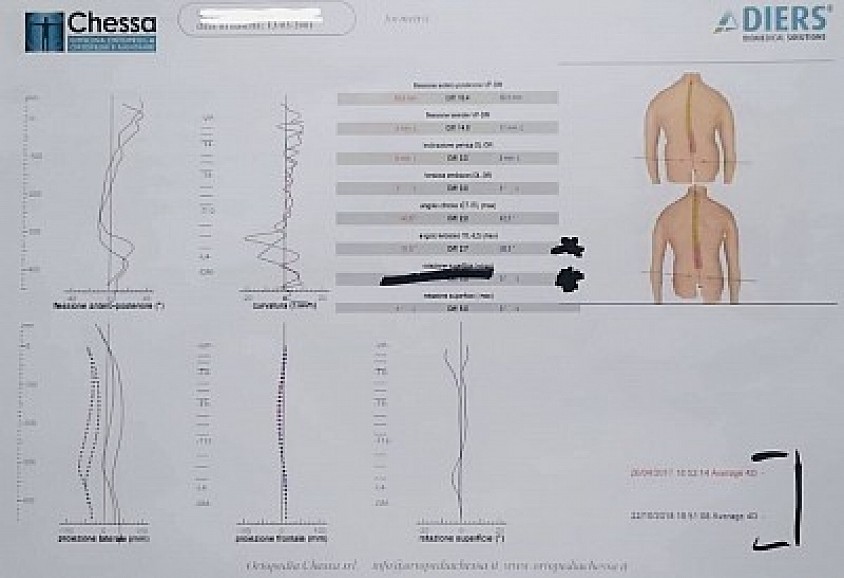
Uneven hips sometimes prompt questions about scoliosis. A step-down or posture photograph can show asymmetry. Diagnosing scoliosis requires a clinical assessment and is usually confirmed with a standing spinal X-ray. In our dynamic posture assessment course, the practical question is how the person transfers weight and whether the movement changes on a repeat trial.
Forward head posture and a kyphotic thoracic posture provide useful information about head and thorax orientation. Compare them during cervical rotation, breathing, overhead reach and trunk extension. Ask whether the movement, load or symptoms change with altered support or a different movement strategy. A visual posture label alone cannot distinguish a structural spinal curve from a flexible movement strategy or determine the underlying cause of symptoms.
Balance Balls, BOSU & Twist Disc Assessment
Use a balance ball, BOSU balance trainer, balance disc or inflatable balance cushion to change the support surface. Compare with stable ground: which leg takes the load, and how do the feet, hips, trunk, arms and grip adapt?
A twist disc lets you observe hip internal and external rotation, the body’s working axis and how it rises or lowers. Compare right and left loading across several tasks. If appropriate, a guarded low slackline can provide another way to observe adaptation.
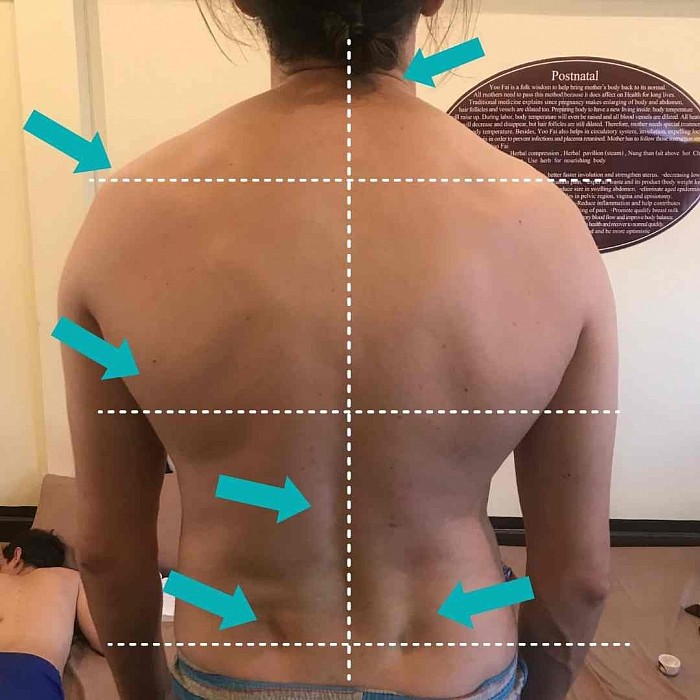
Personalized Postural Massage, Tailored by Analyzing Your Movement
Lower-limb movement and the kinetic chain
For the lower kinetic chain, compare foot pronation and supination, ankle dorsiflexion, knee flexion, hip rotation and pelvic movement during the same task. Normal pronation and supination help adapt the foot to load; neither is automatically pathological. Document side-to-side differences and test a plausible relationship before deciding on movement retraining or manual therapy.
Static posture assessment remains useful as a baseline. It is insufficient by itself when the goal is to understand dynamic posture, joint stability, movement-related pain or sports performance. The assessment should be based on observable movement, relevant anatomy, symptom behavior and comparable functional re-testing.
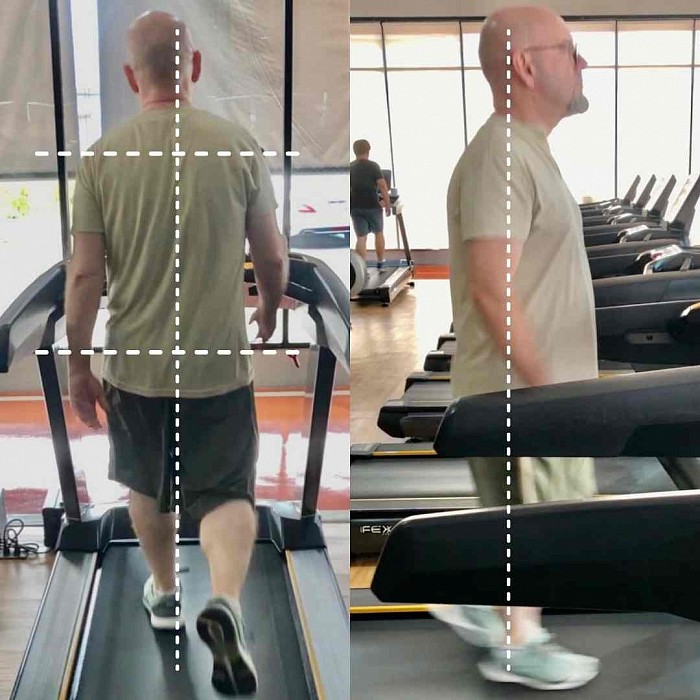
Rather than just prescribing exercises, we consistently track your progress in dynamic postural stability using video recordings
Treadmill Gait and Running Analysis
At a repeatable treadmill speed, compare walking or running strides. Look at foot contact, stride timing, hip and trunk motion, arm swing and vertical displacement.
There is no single ideal gait. Adjust one condition at a time, then see whether the person gains comfort, control or efficiency. Treat a left–right difference as a question to investigate, not a fault to erase.
A supervised recording makes the comparison easier to review. Video is an educational observation tool; it does not diagnose a tissue disorder.
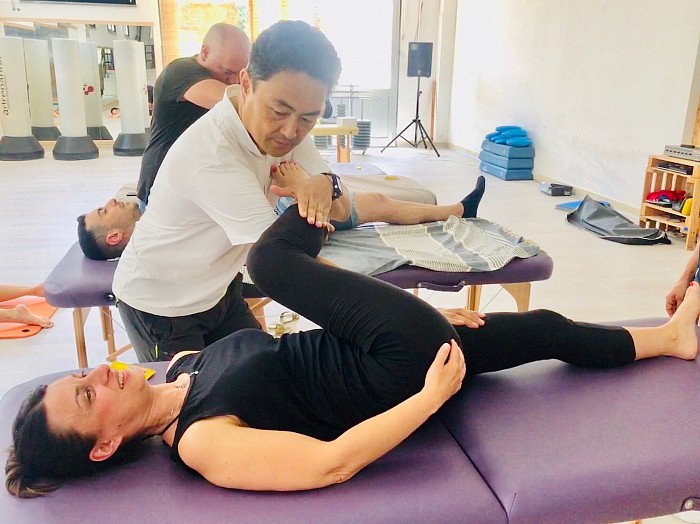
The gluteus maximus and six deep external rotators play a pivotal role in pelvic positioning. Hiro assesses muscle imbalances and applies deep tissue massage, trigger point therapy, and stretching for postural correction and pain relief.
Clinical palpation and manual therapy
A movement finding gives you a question to test. If one heel unloads early in a step-down and the pelvis turns, compare ankle range and hip control. Change the support or cue and repeat the task. When hands-on assessment is appropriate and within your professional scope, palpate the structures your findings point to. Check whether you can identify the same structure at rest and during movement.
Movement retraining and manual therapy are both options. Sometimes a change in timing or support is the more useful starting point. At other times, targeted hands-on work may help you explore a restriction before you return to the movement. Compare the same task after either approach. A short-term change is information to guide your next decision; it does not prove what caused the pain. Manual techniques do not replace a medical assessment when referral is warranted.
Learn this sequence in RSM’s Professional Dynamic Myofascial Release – 7-Day Intensive. Practitioners coming from massage can also use the Dynamic Posture Assessment & Kinetic Chain Training course to bring their table findings back to a real movement task.
Balance Ball YOGA movement practice and postural observation.
Muscle tension, joint mobility and the clinical decision
A report of tightness, palpable resistance or protective muscle activity can inform an assessment but is not proof of fascial adhesion, excessive muscle tension or a particular pain generator. Clinical palpation is combined with movement, loading history and the response to appropriate comparisons. Within professional scope, selected soft-tissue techniques, dynamic stretching or joint mobilization may be considered when the assessment supports them. If the relevant task does not respond, reassess the hypothesis rather than automatically increasing pressure or repeating the same technique.
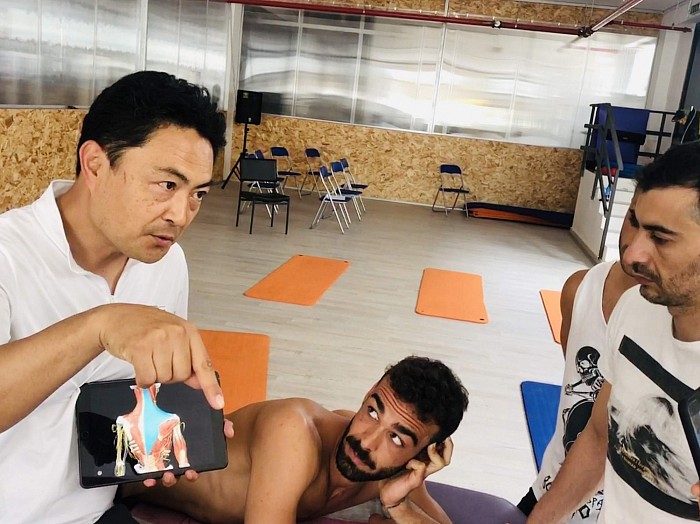
Using the iPad and video analysis, we diagnose your postural concerns and outline a tailored plan for improvement, combining effective training, massage, and stretching techniques
Repeated sporting movements and habitual loading
A right-dominant throwing arm, habitual right-leg weight bearing or repeated rotations in golf, baseball and volleyball may influence a person's movement strategy and loading history. Athletic asymmetry can also represent useful adaptation; symmetry is not a universal treatment goal. Compare left and right support, pelvic rotation, thoracopelvic coordination, scapular upward rotation, scapulothoracic movement, foot pronation and supination, and lumbopelvic rhythm within the relevant sport task. Consider whether a mobility limitation, pain, fatigue, tissue tolerance or technique change is relevant. A reported restriction may justify further clinical palpation or selected manual therapy, followed by the same functional re-test.
Related manual-therapy training
If a muscle-related pain presentation warrants hands-on assessment, explore Trigger Point Therapy. For posture, tissue-layer mobility and joint relationships, explore Deep Tissue Massage. For tissue contact coordinated with motion, explore Dynamic Myofascial Release.
A repeatable decision process
Define the task → Observe movement → Examine a plausible contributor → Select an appropriate intervention → Repeat the same task → Review the response.
The aim is useful movement and improved professional decision-making, not forcing everyone into one posture. Progress may include a more comfortable task, different movement options or greater confidence under an appropriate load. No single test, technique or posture label establishes the cause of symptoms.
Study dynamic posture assessment at RSM
Ready to connect movement findings with hands-on work? Start with the official two-day Dynamic Posture Assessment & Kinetic Chain Training course if your priority is movement analysis. For the combined pathway, explore the Professional Dynamic Myofascial Release – 7-Day Intensive. New to manual therapy? Read the eligibility FAQ before choosing a course.
Dynamic Posture Assessment FAQ
Does an asymmetry need correcting?
Not always. Compare both sides under repeatable conditions and ask whether the difference affects the person’s task, comfort or control. Retest before deciding what to change.
Can I learn movement analysis without enrolling in the intensive?
Yes. Start with the two-day Dynamic Posture Assessment & Kinetic Chain Training. For the combined assessment and hands-on pathway, see the 7-Day Intensive.
