
Balance Ball YOGA — Sports Medicine for Dynamic Postural Stability
Bridging the Gap Between Movement Assessment and Manual Therapy
Written by Hironori Ikeda, M.Sc. Sports Medicine — Founder, RSM International Academy.
Balance Ball YOGA is Hironori Ikeda’s sports medicine approach to movement assessment and training. It asks a practical question: how does a person keep a usable body axis when the support, load or direction changes? The axis is something the person continually reorganises through movement, not a fixed line they must hold.
The feet, hips, pelvis, spine and upper limbs work together to transfer load. A change in support can make a familiar strategy more visible: a shift onto one leg, a change in grip or arm swing, or a trunk movement that compensates for limited joint range. Balance balls, BOSU trainers and discs help us compare those responses with movement on a stable surface. We consider proprioceptive feedback, core muscle activation and the timing of the whole kinetic chain.
Different people solve the same movement task in different ways. We do not correct an asymmetry just because we see it. We compare both sides, change one variable and repeat the task. If the finding warrants it, a trained practitioner can use clinical palpation or targeted manual therapy alongside movement retraining. The aim is to find a strategy the person can use with better control, confidence or comfort.
Start with dynamic posture assessment and kinetic-chain evaluation, or see how assessment and hands-on work come together in RSM’s Professional Dynamic Myofascial Release – 7-Day Intensive. The training is for physiotherapists and other healthcare professionals, massage therapists, sports coaches and trainers, and committed yoga and Pilates instructors.
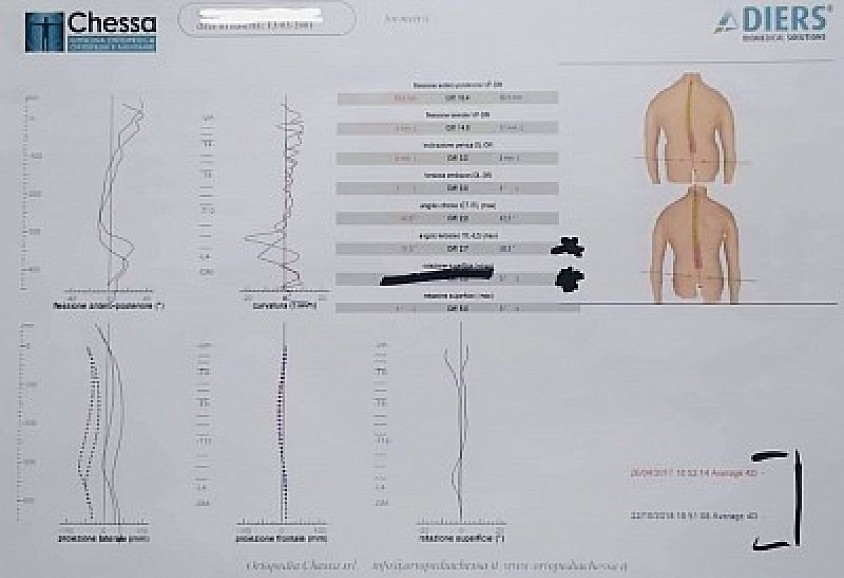
Example of postural assessment documentation.
A background in sports medicine and elite movement analysis
Developed by Hironori Ikeda, M.Sc. Sports Medicine, Balance Ball YOGA grew from his own athletic experience in skiing, motocross and football, repeated video-based movement observation and graduate education at the University of Tsukuba. The university ranked 25th worldwide and first in Japan for Sports-related Subjects in the 2018 QS subject ranking. Ikeda's published research includes anterior cruciate ligament mechanics (2003) and footwear traction on frozen surfaces (2002).
Over approximately three decades, he has translated movement observation, functional anatomy, biomechanics and clinical palpation into a structured educational approach. This is his original Balance Ball YOGA curriculum, not a reproduction of another instructor's teaching system.
In 2027, RSM International Academy is bringing its movement assessment, functional training and manual therapy education together in one professional learning pathway. The programme is intended for practitioners prepared to study anatomy, observe movement, compare functional findings and develop practical hands-on skills. It does not teach spiritual healing, energy work or emotional release.
Discover the founder's academic background and research · Explore the integrated seven-day training programme.
Applications across the lifespan and in sport
The method can be adapted for different ages, fitness levels and movement capacities, with appropriate screening, equipment, supervision and progression. For sports conditioning, it can be used to examine movement sequencing, weight transfer and joint control during repeated or asymmetrical tasks. In rehabilitation settings, appropriately qualified professionals may use selected exercises as part of an individual plan, alongside other indicated care. For children, the focus is age-appropriate movement exploration and motor skills, not promises of spinal correction. For older adults, a stable starting surface, safe support and graded stepping or balance tasks may help develop functional mobility and confidence. General exercise evidence supports balance and functional training for fall prevention; this is not evidence that Balance Ball YOGA prevents dementia, treats structural scoliosis or cures pain. Dynamic Postural Stability · Dynamic Posture Assessment.
Why the name Balance Ball YOGA?
The Sanskrit root yuj, from which the word yoga derives, carries the sense of joining or uniting. Balance Ball YOGA uses this concept in a distinct, contemporary sports-medicine context: uniting the body's functional axis, centre of mass, changing support conditions, sensory feedback and coordinated movement.
The method is not a spiritual, energy-based or emotional-release practice. Its teaching is grounded in functional anatomy, biomechanics, exercise science and the observable response to movement. The word YOGA describes the integration of these elements; it does not imply that we teach a traditional system of yoga philosophy. We respect the distinct history of traditional yoga while defining our own educational method clearly.
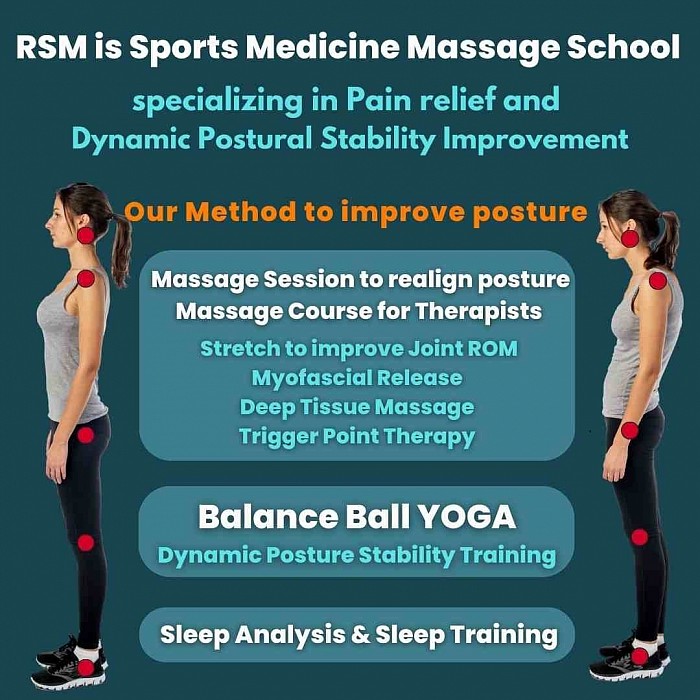

Hiro explain to the student how the body moves to maintain a dynamic posture
Stability through movement, not rigidity
A person who appears to be still is continually making small adjustments to maintain balance. When the body interacts with a moving or compliant support, these adjustments become easier to observe. Balance balls, BOSU trainers, balance discs and twist discs provide different challenges to coordination. The body must regulate its centre of mass relative to the available support while the spine, pelvis, shoulder girdle and limbs work together.
Learn more about Dynamic Postural Stability and Fluid Dynamic Movements.
Functional anatomy, sports medicine and the kinetic chain
The body does not control its centre of mass in isolation. During weight transfer, movement of the foot and ankle interacts with knee and hip mechanics, pelvic tilt and rotation, spinal mobility and shoulder-girdle coordination. Balance Ball YOGA examines these ascending and descending kinetic-chain relationships together with joint range of motion, muscle function and the timing of neuromuscular responses. Proprioceptors contribute sensory information about position, movement and loading; that information helps the nervous system adapt muscular activity to changing support conditions.
Core muscle engagement, anticipatory muscle activation and reactive adjustments are considered in the context of the task. We do not equate stability with constant maximal bracing. Instead, we teach practitioners to observe when muscle activation, movement sequencing or changes in support may be relevant to functional stability and performance.
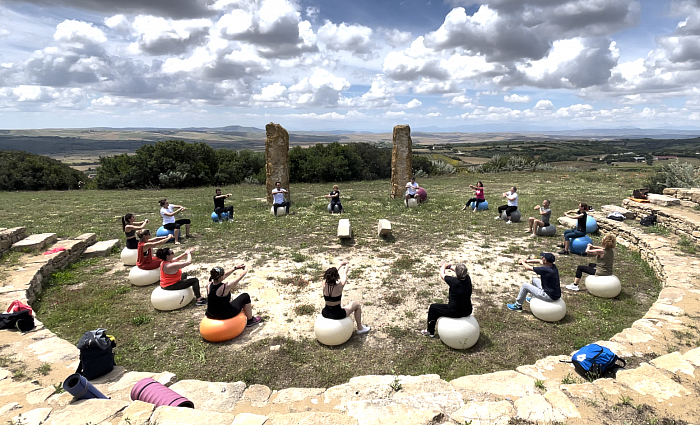
Balance Ball YOGA in Sardigna, Italy 2023
From assessment to a practical intervention
A movement difference is not automatically the cause of pain. Begin with the person's symptoms, history and meaningful task. Observe motion and loading, examine plausible regional contributions, and use appropriate palpation and functional tests. Select an intervention within professional scope, repeat the original task and compare the response.
Movement practice and manual therapy are complementary skills. Exercise may help a person explore new movement options; targeted hands-on work may be useful for selected symptoms or mobility restrictions. Neither is a universal solution.
Professional education in Chiang Mai
The two-day Dynamic Posture Assessment & Kinetic Chain Training develops movement observation and video-analysis skills. The seven-day intensive extends these findings into Dynamic Myofascial Release and Sports Medicine Massage.
Practitioners who need a foundation in anatomy and clinical palpation should begin with Trigger Point Therapy, followed by Deep Tissue Massage. Advanced direct entry requires RSM's assessment of the applicant's documents and skills.
Professional Dynamic Myofascial Release – 7-Day Intensive · View current dates and fees · Entry requirements & student FAQ.
Balance Ball YOGA FAQ
Is Balance Ball YOGA a yoga class?
No. It uses changes in support to study dynamic postural stability and how a person distributes load. It is professional movement education, with manual therapy taught through the appropriate RSM pathway.
Where should I begin?
Choose dynamic posture assessment for movement analysis. For hands-on foundations, start with Trigger Point Therapy. See course eligibility and the student FAQ before booking.
